


The world of payments is evolving at lightning speed, and vending operators are right in the middle of it. But with change comes questions—do contactless payments without a PIN really work? Are decline rates an issue? Should operators be worried?
Vendon’s CEO, Kristians Vebers, has some strong opinions on the matter (and the data to back them up). In this piece, he shares why PIN-free payments are not just the future but the smartest move for vending businesses today.
Decline rates are low
Let’s start with the numbers: Vendon’s recent data shows that only 2.4% of contactless declines happen because of insufficient funds, and just 1.9% are due to PIN requests. But the rest? Those declines come down to vending-specific issues, not actual payment failures. So, it’s more likely for someone to have too little money in their account than for their bank to ask for a PIN. The bottom line? The vast majority of contactless payments sail through, showing that not requiring a PIN doesn’t cause problems.
How often do you actually need a PIN?
Contactless payments sometimes require a PIN, but the rules are specific. European banks and networks like Visa and Mastercard follow security guidelines. For example, after five consecutive contactless transactions or if the total reaches 150 EUR since your last PIN entry, a PIN will be requested. The general limit for contactless payments without a PIN is 50 EUR across most of Europe.
With Apple Pay and Google Pay, PINs are rarely needed due to added security features like facial recognition or fingerprints, allowing PIN-free transactions. A new “PIN Online” feature is also rolling out, enabling users to enter a PIN for payments over 50 EUR without inserting the card, expected to be available widely by 2024.
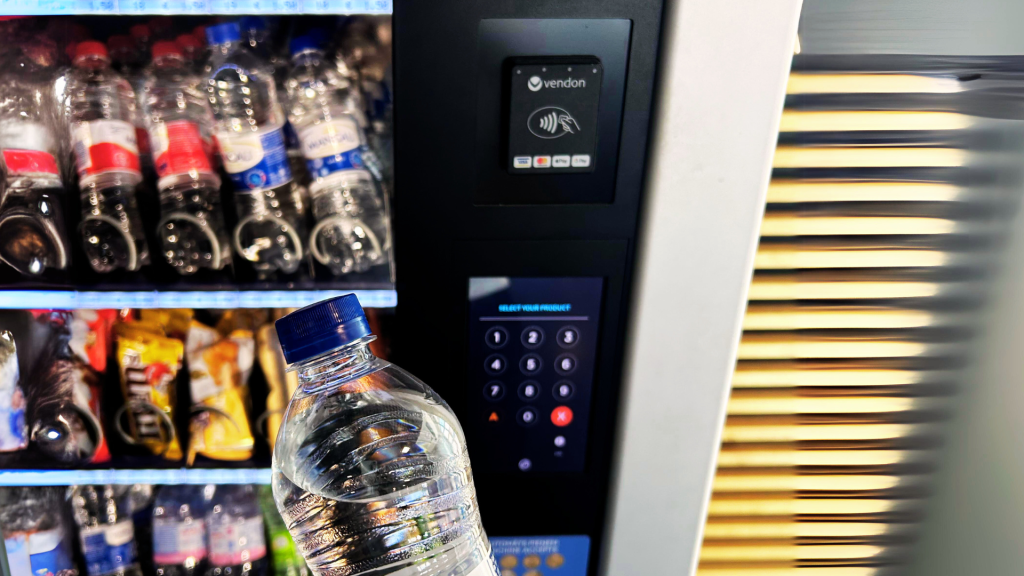
Kristians Vebers, CEO of Vendon, shared his experience:
“I recently bought a bottle of water at Riga Airport from a vending machine with a Vendon payment terminal. It took just 10 seconds—quick, simple, and efficient. Adding a PIN would only complicate things and slow down the transaction.” With contactless payment growing by 30% in recent years, getting in now means being ready for a more cashless future.
Contactless is changing consumer spending
Contactless transactions have been on the rise, jumping up by 24.3% in the first half of 2023 alone, reaching nearly 21 billion payments across Europe. In some countries, over 80% of retail transactions are now cashless, especially in sectors like vending, where quick, easy payments are key. When customers use card payments, studies show they often spend more. So for vending operators, adopting contactless isn’t just about convenience; it’s about capturing those spur-of-the-moment purchases.
The benefits of Vendon contactless payment terminal
Vendon’s payment terminals support various payment methods—from contactless credit and debit cards to NFC-enabled devices like smartphones. This flexibility helps vending operators serve all customer types, boosting business. Plus, faster, simpler refunds lead to fewer complaints and happier customers. Reducing cash handling lowers service visits and operational costs, adding long-term savings, while funds reach operators by the next day to keep cash flow steady.
Vendon is also PCI DSS L1 Service Provider and EMV Level 3 compliant, ensuring secure transactions in about three seconds. If a transaction fails, funds are returned quickly, maintaining high reliability.
PIN-free, worry-free
For those concerned that going contactless could lead to higher decline rates, the data speaks for itself: PIN-free payments work smoothly, which means no added PIN input actually makes transactions faster without impacting success rates. Vendon payment terminal is built for modern needs, offering a balance of advanced tech, user-friendliness, and security.
Operators who embrace this technology are seeing growth in sales, lower costs, and a simplified business model. Vendon payment terminal is affordable, easy to install, and ready to meet today’s demands—helping operators set up for long-term success in a cashless economy. So why wait? Join the future of payments with Vendon and give your business a lift today.