

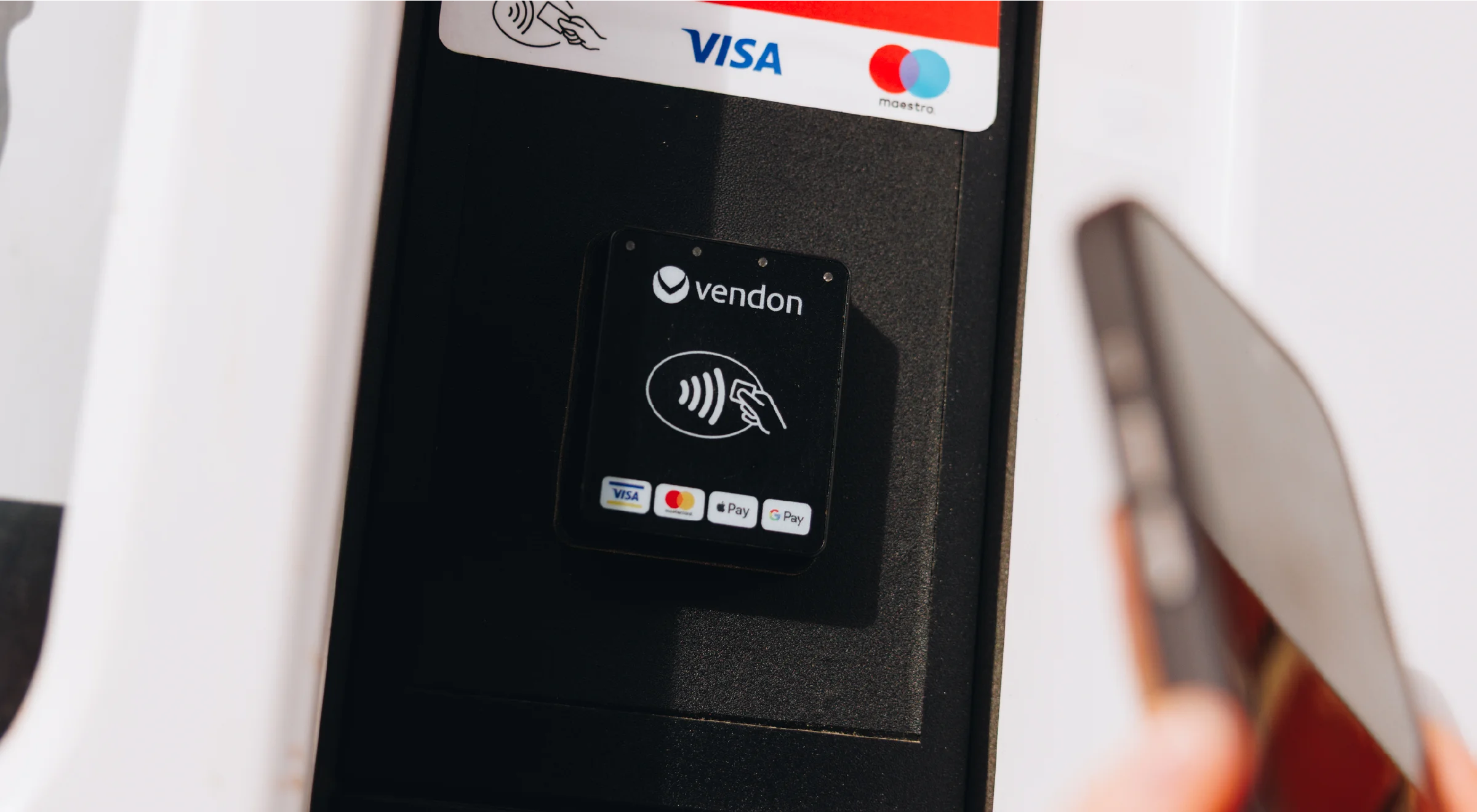
Quick answer: The best vending machine card reader is the one with the highest real-world authorization rate, reliable connectivity with offline transaction buffering, transparent settlement, responsive support, and integrated reporting — not the one with the lowest sticker fee. Top-performing systems like Vendon’s card reader reach a 97% authorization rate and complete transactions in under 3 seconds; a 2–3% authorization gap across a fleet outweighs any difference in transaction fees.
If you’re comparing card readers, you already know what they do.
What you actually need to know before signing a contract:
- Which system approves the most transactions in real vending conditions?
- What does total cost of ownership look like beyond the hardware price?
- Standalone terminal or integrated ecosystem — which pays off long term?
- How do you verify a vendor’s claims — and their support — before committing your fleet?
This guide breaks down the 10 evaluation criteria experienced operators use, the questions to put to every vendor, and the red flags that predict problems after installation.
Comparing systems is step one. Once you’ve chosen, here’s how to install a card reader on a vending machine.
Table of Contents
1. Authorization rate — your real revenue metric
Authorization rate is the percentage of payment attempts that get approved rather than declined. It’s the single biggest revenue lever in this comparison: a 2–3% difference in authorization across your fleet compounds into significant annual revenue — far more than marginal differences in transaction fees.
No system hits 100%, but the benchmark to hold vendors to is high: Vendon’s card reader maintains a 97% transaction success rate in real unattended-retail conditions. Systems optimized for vending consistently outperform generic retail terminals because they handle weak connectivity better, retry intelligently, and manage timeouts without abandoning the sale.
Ask every vendor:
- What is your real authorization rate in unattended environments — not lab conditions?
- Can I see decline reasons per machine?
- What’s the average tap-to-vend time?
A vendor that shares authorization data transparently is telling you something about their reliability. A vendor that dodges the question is too.
2. Network reliability, offline capability, and failure alerts
Vending machines live in the worst places for signal: basements, transport hubs, industrial estates, hospitals. Signal variability isn’t an edge case — it’s the operating environment.
A professional-grade system should provide:
- Multi-network SIM support with automatic network switching
- Smart retry logic instead of instant declines on weak signal
- Remote signal diagnostics so you can see connectivity per machine
- Offline transaction buffering — transactions are stored locally when connectivity drops and synchronized once signal returns
Just as important: how fast do you find out when a reader fails? A card reader that’s down is a machine earning nothing, and without monitoring you typically learn about it days later from a customer complaint or a collection visit. With Vendon, a failure triggers a Vendon Cloud alert within minutes, so a problem gets fixed the same day instead of quietly draining a week of sales.
Not all readers support offline buffering or real-time failure alerts, so put both on your comparison checklist explicitly.
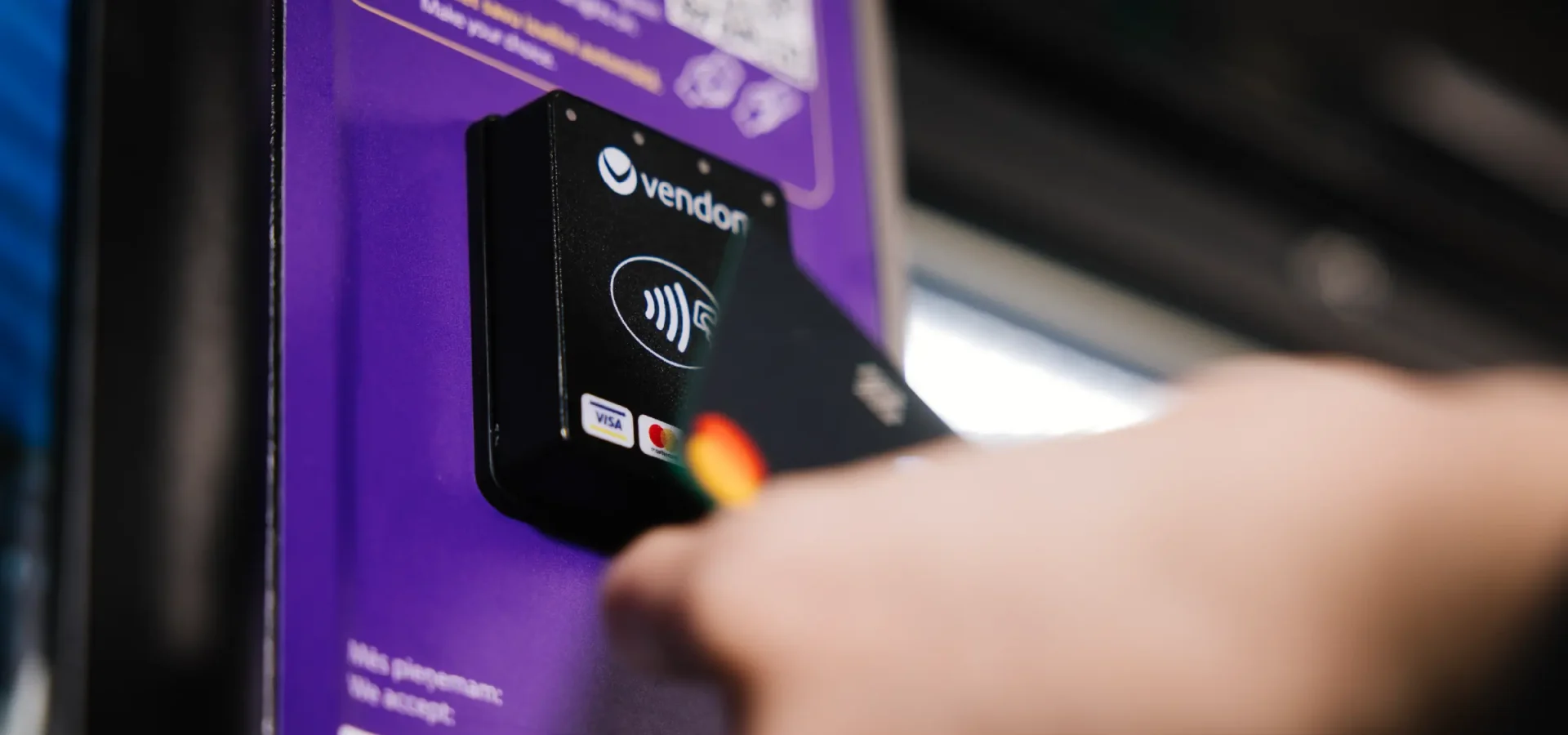
Watch how the Vendon card reader works in real vending environments:
3. Integrated ecosystem vs. standalone terminal
Many vending payment setups are stitched together: hardware from one vendor, payment processing from another, connectivity from a third, reporting from a fourth. Every one of those seams is a place where troubleshooting stalls and accountability disappears.
Integrated systems put payments, connectivity, telemetry, and reporting on one platform. Vendon’s card reader operates inside Vendon Cloud, which means:
- Unified telemetry and payment reporting in one view
- Centralized fleet monitoring with real-time transaction status and failure alerts
- One support contact when something breaks — no vendor finger-pointing
For a handful of machines, fragmentation is an annoyance. At fleet scale, it’s an operational cost you pay every week.
4. Payment method coverage and loyalty integration
Accepting contactless cards is the baseline. Check what else the reader supports, because payment coverage directly determines how many customers can actually buy:
- Contactless debit and credit cards
- NFC payments — Apple Pay, Google Pay, smart devices
- Closed-loop and app-based payments
- Loyalty integration — Vendon’s reader works with loyalty solutions like QuickPik, so repeat customers earn rewards and pay through the app on the same hardware
Loyalty is the sleeper factor here: a card reader that doubles as a loyalty touchpoint turns one-time buyers into repeat revenue without additional equipment.
5. Reporting and cash control depth
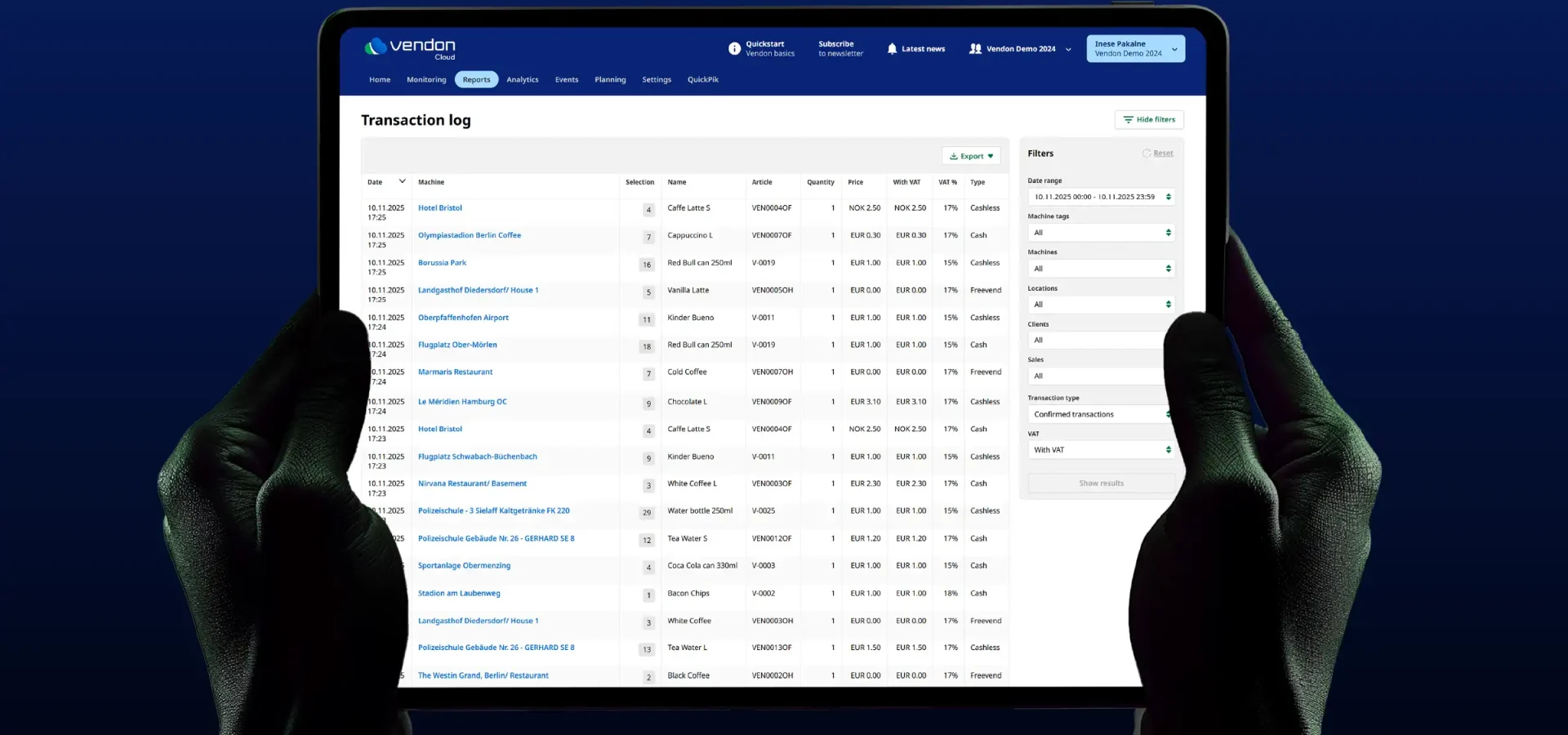
Transaction lists are table stakes. What separates systems is whether the reporting supports actual financial oversight:
- Machine-level revenue reporting
- Cash vs. cashless comparison per location
- Settlement figures that reconcile against actual transactions
- Exportable, accounting-ready reports
Operators running mixed cash/cashless fleets typically pair this with cash control solutions that consolidate sales, payout, and reconciliation in one workflow. As fleet size grows, reporting depth stops being a nice-to-have and becomes the thing your accountant asks about first.
6. Settlement transparency and the real fee structure
The advertised transaction fee is the least interesting number in the contract. Before committing, get clear answers on:
- Settlement frequency — daily, weekly, or monthly, ideally your choice
- Fee structure — blended rate or interchange++?
- Deduction method — are fees taken before payout, and can you see the breakdown?
- Reconciliation — can you match every settlement to its transactions without manual detective work?
A low sticker fee means nothing if you can’t reconcile settlements to sales. Settlement transparency deserves the same weight in your comparison as authorization performance.

7. Refund and dispute workflows
Refunds and chargebacks are where payment systems reveal their maturity. In unattended retail there’s no staff member on-site to resolve a failed vend — the system has to do it.
Evaluate:
- Remote refund capability, linked to the original transaction
- Refund visibility in standard reporting
- Access to dispute documentation
- Whether the provider actively assists during chargeback resolution
A clean remote refund workflow protects customer trust at exactly the moment it’s most at risk.
8. Transaction speed and consistency
Slow payments kill impulse purchases. The benchmark: Vendon’s card reader completes a transaction in under 3 seconds from tap to vend. If a vendor can’t quote a comparable figure, ask why.
The metric that matters just as much is consistency — a reader that’s fast at 9 a.m. but times out during the lunch rush costs you sales at precisely the highest-demand moments.
Ask:
What is the average tap-to-vend time, performance under peak load, and whether pre-authorization is used to accelerate the transaction flow.
9. Scalability and remote management
The purchase decision is day one. Total ROI is determined by the years after:
- Remote firmware updates (no site visits for maintenance)
- Centralized, remote price management
- Multi-location deployment from one dashboard
- Fleet-wide configuration control
If adding machine #50 requires the same manual effort as machine #1, the system doesn’t scale — it just accumulates.
10. Vendor support responsiveness — test it before you buy
This is the criterion operators most often skip during comparison and most regret after. A common complaint about card reader suppliers is support that takes days to respond — and in unattended retail, every hour of reader downtime is unrecoverable revenue. A cheap reader with unreachable support is the most expensive reader on the market.
Investigate before you sign:
- Send the vendor’s support a pre-sales technical question and time the response
- Ask existing customers how fast real issues get resolved
- Check what support channels exist (phone, email, in-platform) and their hours
- Confirm whether support covers the whole stack or just the hardware
Responsive support is a core part of Vendon’s offer — questions get answered fast, and because payments, connectivity, and telemetry sit on one platform, there’s one team accountable for the whole system rather than three vendors pointing at each other.
How much does a vending machine card reader cost?
Total cost of ownership includes hardware purchase, monthly service fee, transaction percentage, SIM/data charges, and optional telemetry or reporting subscriptions.
The comparison mistake to avoid: optimizing for the cheapest hardware. Authorization performance, network resilience, and reporting clarity move revenue far more than marginal fee differences. A reader that costs €50 less but declines 3% more transactions is the expensive option.
Which vending machine card reader is best?
There’s no universal “best” — the right system depends on fleet size, machine compatibility, location connectivity, reporting needs, and growth plans.
The pattern that holds across operator types: integrated systems that combine payments, telemetry, and reporting outperform standalone terminals over time, because the value compounds — better decline diagnostics, unified reconciliation, remote management, one support relationship.
Vendon’s card reader inside Vendon Cloud is built specifically for unattended retail: reliable contactless payments, unified telemetry and sales visibility, and remote fleet monitoring in one platform.
Frequently asked questions
What is the most important factor when comparing vending machine card readers?
Authorization rate. It measures how many payment attempts are approved in real conditions, and a 2–3% difference across a fleet outweighs any difference in transaction fees. Ask vendors for real unattended-retail authorization data, not lab figures.
Can vending machine card readers process payments offline?
Some can. Systems with offline transaction buffering — typically backed by telemetry infrastructure — store transactions locally during connectivity drops and synchronize them once signal returns. Not all readers support this, so verify it before buying if your locations have weak signal.
How much does a vending machine card reader cost in 2026?
Expect hardware purchase plus a monthly service fee, a transaction percentage, SIM/data charges, and optional telemetry or reporting subscriptions. Total cost varies by provider and fleet size — and total cost of ownership matters more than hardware price.
Is an integrated card reader better than a standalone terminal?
For most operators managing more than a few machines, yes. Integrated systems combine payments, telemetry, reporting and loyalty on one platform, which simplifies troubleshooting, reconciliation, remote management and business growth. Standalone terminals can work for very small deployments not looking to scale.
Do card readers increase vending machine sales?
Yes — operators consistently report higher sales after adding contactless payment, driven by convenience and higher average transaction values. Customers without cash stop being lost sales.
Are vending machine card readers secure?
Professional systems are PCI DSS compliant and use encrypted communication for all payment processing. Verify compliance certification as part of vendor due diligence.
Final buying checklist
✔ Real vending authorization rate (benchmark: 97%)
✔ Network resilience and offline transaction buffering
✔ Failure alerts — how fast will you know a reader is down?
✔ Payment coverage: NFC, closed-loop, loyalty integration
✔ Integrated ecosystem vs. fragmented vendor stack
✔ Reporting and reconciliation depth
✔ Settlement transparency and full fee structure
✔ Remote refund and dispute workflows
✔ Scalability and remote fleet management
✔ Support responsiveness — tested before signing