

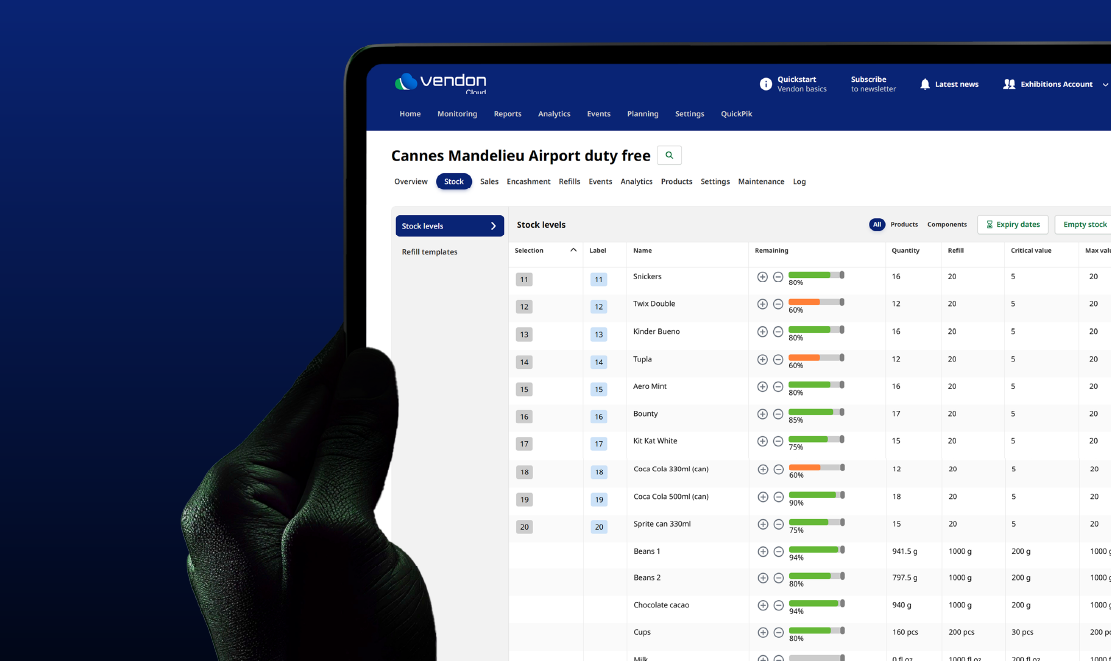
Quick answer: Live stock visibility, or real-time stock monitoring, increases vending sales by closing the gap between the moment a spiral runs empty and the moment someone finds out. A connected machine reports every vend as it happens, so operators refill the spirals that are actually emptying, carry the right quantities, and set product mix per machine instead of per route.
Every operator knows the scenario. The machine is online, the payment terminal is fine, the sales report shows a normal Tuesday. Meanwhile the best-selling water spiral has been empty since 11:40, and nobody will see it until Thursday’s visit.
The EVA Market Report 2024 counts 94.6 million vends a day across Europe, so those quiet gaps add up fast. This guide covers where sales leak between visits, which signals to watch, and how operators turn vending inventory management into routes, pick lists and planograms.
Where do vending machines lose sales between refill visits?
Most lost sales happen on machines that are technically working. A machine with one empty top-seller still shows as online, so a fixed weekly route never flags it. The loss is selling time: hours or days when a customer walks up, finds nothing they want, and leaves.
The leaks operators see most often:
- The single-spiral stockout. One fast mover empties while the machine is 70% full. Visit-based schedules miss it because the machine “looks” stocked.
- The uneven location. Two identical machines on the same route sell at completely different speeds. Refilling both on the same day overstocks one and starves the other.
- The expiry write-off. Sandwiches, dairy snacks and short-dated drinks pass their date in a slow machine while the same product sells out in a busy one.
- The machine that stops selling. A full machine with a faulty coin changer or bill validator records zero sales. As Vendon’s guide to cash control points out, stock is fine but availability is not.
The common thread: without live data, operators learn about the problem during the next visit, or from a customer complaint.
Which stock signals should vending operators monitor?
Watch four signals in your vending machine stock management: product level per spiral, critical-product status, expiry date, and sales velocity per machine. Level alone tells you what is empty now. Velocity tells you what will be empty before the next visit, which is the number that actually protects revenue.
Five stock signals every vending operator should watch
Level shows what is empty now. Velocity shows what will be empty before the next visit.
| Signal | What it catches | How to set it up in Vendon Cloud |
|---|---|---|
| Product level per spiral | Single-spiral stockouts on a machine that looks full | Max value = spiral capacity. Refill value = the level you actually fill to. |
| Critical product flag | Top-sellers that must never run out | The machine joins the visit list when that product is low, even if the rest is full. |
| Expiry dates | Write-offs and food-safety risk | Inventory report highlights past-due items in red. |
| Sales by day | Weekday peaks and slumps | Sales report with “Group by days”. |
| Sales stop alert | A stocked machine that has stopped vending | Notification when sales stop or a payment device reports a fault. |
Vendon’s walkthrough of product profiles shows a time-saver here: set refill values at product level and they prefill automatically whenever you add that product to a new machine.
How does live stock data change refill routes and pick lists?
It turns a fixed route into a need-based one. Instead of visiting every machine on its scheduled day, drivers visit the machines that need product, carrying a pre-packed box per machine built from live stock levels.
The workflow operators run with Vendon:
- Set a minimum pick-list value. Example: a product only appears on the pick list once at least 5 units have sold. Machines with trivial gaps stay off today’s route.
- Generate the pick list from live stock. The warehouse packs one box per machine with exact quantities, the approach described in Vendon’s article on the five sales challenges telemetry solves. Drivers stop topping up by eye.
- Build the route from need, not habit. Route planning can combine refills with encashment and coin-tube tasks, so one stop covers everything.
- Confirm at the machine. In Vendon Mobile, drivers see planned versus filled amounts and can correct stock on the Inventory screen, which keeps the next pick list accurate.
The refill value is where experienced operators find hidden stock. A spiral that holds 15 bottles but never sells more than 10 between visits can be refilled to 10. The other five go to a busier location instead of sitting in a quiet machine.
Why do demand peaks expose weak stock visibility?
Peaks compress a week of sales into a day, so a machine that was fine on Monday can be empty by Wednesday lunch. Hot weather, a full office after a holiday, or a trade fair in a venue all shift demand faster than any fixed schedule can follow.
Three patterns worth building rules for:
- Weather-driven cold drinks. Water and iced drinks accelerate first. Flag them as critical products for summer so they pull machines onto the route early.
- Workplace rhythm. Office and factory machines peak mid-week and around shift changes, then go quiet on weekends. Refill before the peak day, not after it.
- Event spikes. Temporary footfall needs a temporary refill value. Raise it for the event week, then drop it back so stock does not sit.
The day-by-day view in the Vendon sales report makes the weekly pattern visible, so refills can land before the busiest day instead of after it.
How does stock data improve product mix per location?
It replaces a route-wide planogram with one that matches each machine’s real sell-through. When stock movement is visible per spiral, operators give top-sellers more facings, cut slow movers, and the machine empties evenly instead of around one gap.
This is where the biggest gains show up. Vendon Cloud’s product shelf analysis recommends facings from historical sales, and one Vendon client saw its machines reach twice the industry average once it started analysing product sales this way.
Use the refill value to move stock between machines. If a spiral holds 15 but only sells 10 between visits, fill it to 10 and send the surplus to the location that sells out. The machine carries less idle stock and the busy one stops running empty.
Stock data also makes product and price tests measurable. Swap a slow mover for a trial product in a few machines, or adjust price by location, and compare sell-through per spiral after two or three refill cycles. The inventory report lists the price of each product in every machine, so inconsistencies are easy to spot and fix remotely.
Is your fastest-selling product also your most profitable one?
Often it is not. Units sold measures popularity; profit per spiral measures value. A product that sells out every week at a thin margin can earn less than a slower item with double the margin, and it also pulls the machine onto the route more often.
A simple illustration of the gap (example figures):
Your best seller is not always your best earner
Same machine, same week. Rank products by profit per spiral, not units sold.
| Product | Units sold per week | Margin per unit | Profit per week |
|---|---|---|---|
| Energy drinkEarns the most | 12 | €0.80 | €9.60 |
| Branded colaSells the most | 20 | €0.30 | €6.00 |
40% fewer sales, 60% more profit from the same spiral.
The cola looks like the star in a sales report. The energy drink earns 60% more from the same spiral.
How to run this analysis on your fleet:
- Add cost prices. With the cost price and profit module, the inventory report shows revenue, cost and profit for all stock in every machine, not just units.
- Rank by profit per spiral, not units. Sort products per machine by weekly profit. Give extra facings to the leaders.
- Count the refill cost. A low-margin fast mover that forces an extra visit can cost more in route time than it earns.
- Keep traffic drivers, reprice them. Some fast sellers bring customers to the machine. Keep them, but test small price moves. Among the pricing strategies real operators use, one passed a €0.04 water cost increase on as €0.05 across 200 machines with no visible customer reaction.
Which Vendon Cloud tools turn stock visibility into action?
Vendon Cloud’s vending machine telemetry connects stock data to the field, the warehouse and the back office, so a low-stock signal becomes a packed box, a route stop and a margin figure.
From stock signal to action in Vendon Cloud
How live stock data turns into a packed box, a route stop and a margin figure.
| Operator goal | Vendon Cloud tools | Benefit |
|---|---|---|
| Never miss a top-seller | Live stock levels, critical products, low-stock alerts | More revenueNo lost salesHappier customers |
| Refill the right machines | Route planning, pick lists, Vendon Mobile | Fewer visitsFuel savingsFaster refills |
| Combine tasks per stop | Route planning with encashment and coin-tube tasks | Time savedFuel savingsLower route costs |
| Avoid write-offs | Expiry date tracking, inventory report | Less wasteFood safetyLower stock costs |
| See value tied up in stock | Inventory report with cost price and profit module | Margin controlLess idle stockBetter cash flow |
| Adjust commercially | Remote price changes | Higher marginNo site visitFaster price tests |
| Connect the business | API integrations with ERP and warehouse systems | Less adminFewer errorsFaster invoicing |
Stock control works best alongside machine monitoring and preventative maintenance: an available product only sells on a machine that is running.
Frequently asked questions
How does real-time stock monitoring increase vending sales?
It shortens the time a product stays out of stock. Operators see which spirals are emptying, refill those machines first, and carry exact quantities. Fewer hours with an empty top-seller means more completed vends from the same fleet.
What is a minimum pick-list value in vending?
It is the number of units that must be missing before a product appears on the pick list. Setting it at 5, for example, keeps machines with small gaps off the route, so drivers only stop where a refill is worth the trip.
What is a critical product in vending stock control?
A critical product is a top-seller flagged so that its low stock alone puts the machine on the visit list, even when the rest of the machine is nearly full. It protects the items that drive most of a location’s revenue.
What is a refill value in vending?
The refill value is the level a spiral is filled to on each visit. It can be lower than the spiral’s maximum capacity. If a spiral holds 15 but sells 10 between visits, filling to 10 frees 5 units for a busier machine and cuts idle stock.
Is the best-selling vending product always the most profitable?
No. Profit depends on units sold multiplied by margin per unit, minus the refill visits a product triggers. A slower product with a higher margin often earns more per spiral than a fast, low-margin top-seller. Rank products by profit per spiral, not by units.
How often should a vending machine be refilled?
As often as its sales velocity requires, not on a fixed day. Live stock data lets fast locations get more frequent visits and slow ones fewer, with refill values set to what each spiral actually sells between visits.