
If you are comparing vending machine card readers, you’re not just learning what they are — you’re deciding which system to invest in.
You want answers to questions like:
- Which card reader for vending machines performs best in real life?
- What does a vending machine card reader cost?
- How do authorization rates differ between systems?
- Should I choose a standalone terminal or an integrated solution?
This guide breaks down the commercial differences, real-world performance factors, and evaluation criteria you should use before making a purchase.
Table of Contents
What is a vending machine card reader?
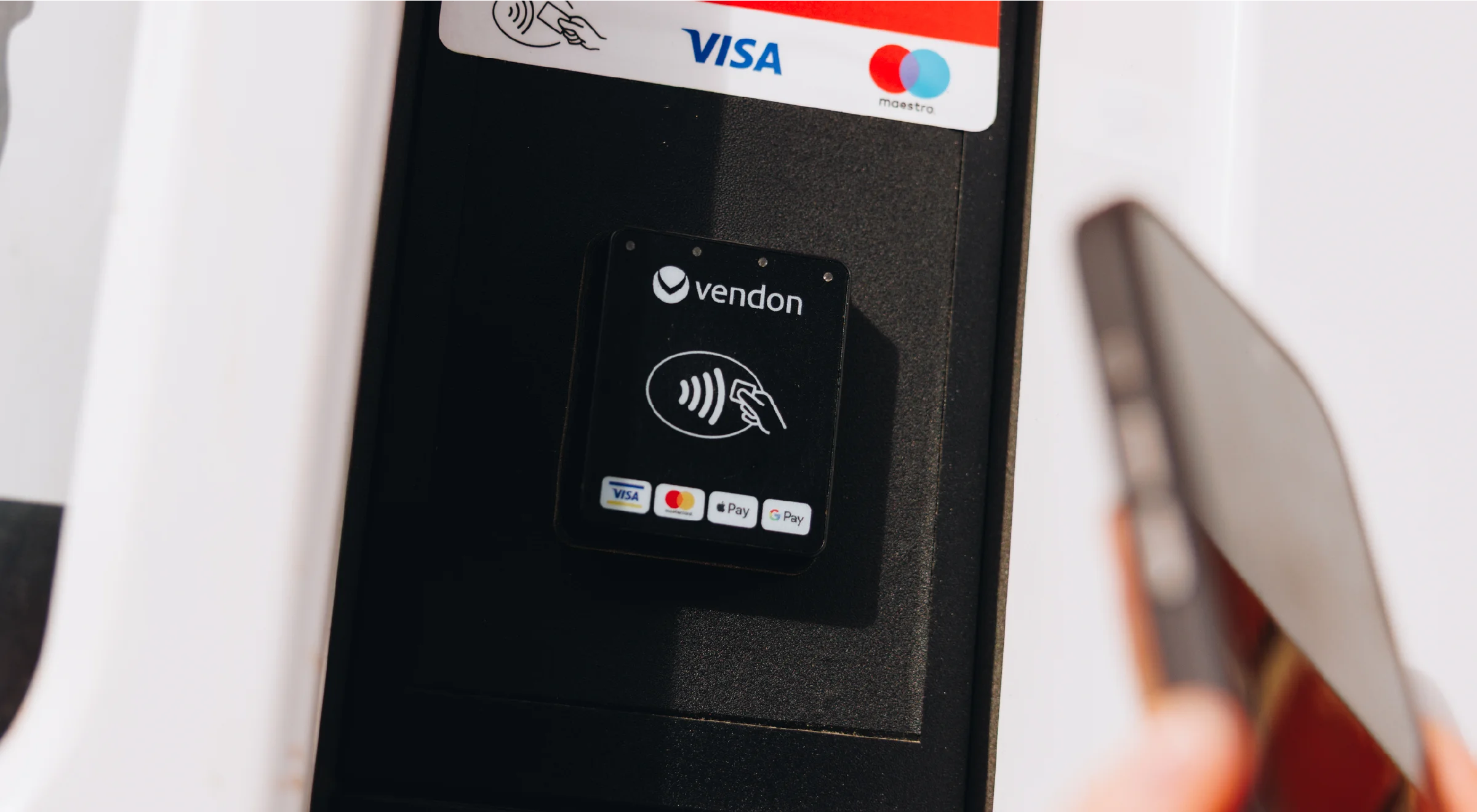
A vending machine card reader is a contactless payment terminal installed on an unattended vending or coffee machine that enables customers to pay using:
- Debit and credit cards
- Contactless NFC payments
- Apple Pay and Google Pay
- App-based or closed-loop payments
Modern readers connect through MDB and use secure cellular connectivity to authorize transactions in real time. But the reader itself is only one part of a broader cashless vending payment system, which also includes:
- The payment gateway
- Mobile connectivity (SIM)
- Settlement and reporting
- Management platform
- Technical support
- (In advanced systems) telemetry integration
When comparing vending machine card readers, you are evaluating that entire ecosystem — not just hardware.

Why install a card reader on your vending machine?
Demand for contactless payment is now the norm in unattended retail. Customers expect quick, frictionless transactions — and operators see real commercial benefits:
- Higher average transaction value
- Fewer lost sales
- Reduced cash collection and handling costs
- Better visibility into cashless performance
Cashless sales are no longer a nice-to-have — they’re business drivers.
For installation help, see this step-by-step guide: How to install a card reader to a vending machine.
How to compare vending machine card readers (a practical buying guide)
Below are the most important criteria operators should use to compare systems before investing.
1. Authorization rate (your real revenue metric)
Authorization rate measures how many payment attempts are approved versus declined.
Even a 2–3% difference in authorization across your fleet can represent significant annual revenue.
Ask vendors:
- What is your real authorization rate in unattended retail environments?
- Can I see decline reasons per machine?
- What is the average tap-to-vend time?
No system achieves 100% approval — but systems optimized for vending consistently outperform generic retail terminals because they:
- Handle weak connectivity better
- Retry intelligently
- Manage timeouts effectively
Transparency on authorization performance is a strong early indicator of real-world reliability.
2. Network reliability and offline transaction capability
Vending machines often operate in weak-signal areas:
- Basements
- Transport hubs
- Industrial estates
- Hospitals
Signal variability is normal.
A professional vending machine card reader should provide:
- Multi-network SIM support
- Automatic network switching
- Smart retry logic
- Remote signal diagnostics
- Offline transaction buffering (when backed by telemetry)
Offline capability is especially valuable. With supported telemetry infrastructure, transactions can be temporarily buffered when connectivity drops and synchronized once signal returns — reducing lost sales in unstable environments.
Not all readers support this, so include it in your comparison checklist.
Watch how the Vendon card reader works in real vending environments:
3. Integrated ecosystem vs standalone terminal
Some vending payment solutions are fragmented:
- Hardware from one vendor
- Payment processing from another
- Connectivity from a third
- Reporting from yet another
That fragmentation makes troubleshooting slow and uncertain.
Integrated systems combine all these elements into one platform.
Vendon’s card reader operates inside Vendon Cloud, enabling:
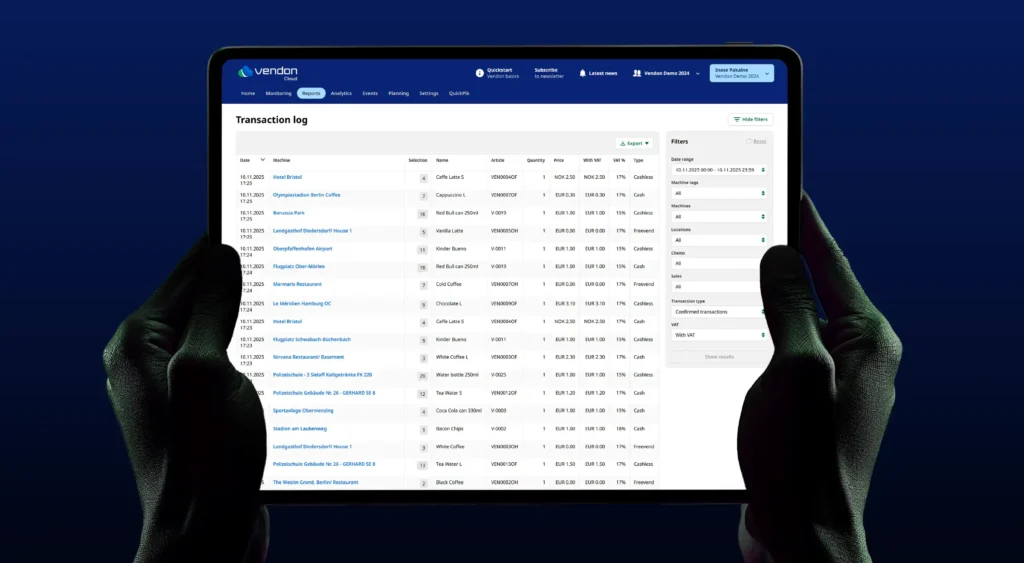
- Unified telemetry and payment reporting
- Centralized fleet monitoring
- Real-time transaction status
- Reduced support complexity
For operators managing larger fleets, integration simplifies operations and avoids siloed systems.
4. Reporting and cash control capabilities
A vending machine card reader should do more than show transactions — it should support financial oversight.
Look for:
- Machine-level reporting
- Cash vs cashless comparison
- Settlement alignment with actual transactions
- Exportable accounting reports
Operators with higher reporting needs often use integrated cash control solutions that consolidate sales, payout, and reconciliation workflows.
As fleet size increases, detailed reporting becomes essential — not optional.
5. Settlement transparency and payment fees
Transaction fees are only one part of cost.
Before choosing a card reader system, clarify:
- Settlement frequency (daily, weekly)
- Fee structure (blended vs interchange++)
- Whether fees are deducted before payout
- Access to detailed settlement breakdowns
Low sticker fees mean nothing if you cannot match settlements to sales easily.
Transparent settlement reporting matters as much as authorization performance.
6. Refund and dispute workflows
Refunds and chargebacks test the maturity of payment systems.
Evaluate:
- Remote refund capability
- Ability to link refunds to original transactions
- Visibility of refunds in reporting
- Dispute documentation access
- Provider assistance during chargeback resolution
In unattended retail, simple, remote refund workflows protect customer trust and reduce operational friction.

7. Transaction speed and customer experience
Slow payments lead to abandoned purchases.
When comparing readers, ask:
- How long does tap-to-vend take on average?
- Does performance degrade during peak usage?
- Is pre-authorization used to speed transactions?
Consistency matters more than occasional speed spikes — stable performance improves customer satisfaction and sales.
8. Scalability and remote management
A vending machine card reader should support growth:
- Remote firmware updates
- Centralized pricing management
- Multi-location deployment
- Fleet-wide configuration control
Installation is day one — long-term management determines ROI.
For installation help, see this step-by-step guide: How to install a card reader to a vending machine.
How much does a vending machine card reader cost?
Cost structures typically include:
- Hardware purchase
- Monthly service fee
- Transaction percentage
- SIM/data charges
- Optional telemetry or reporting subscription
Cheapest hardware does not mean lowest total cost of ownership.
Authorization performance, network resilience, and reporting clarity are bigger revenue drivers than marginal fee differences.
Which vending machine card reader is best?
There is no single “best” reader for everyone.
The right choice depends on:
- Fleet size
- Compatibility
- Location types
- Reporting needs
- Connectivity environments
- Growth plans
For many operators, an integrated system that combines payments, telemetry, and reporting delivers better long-term results than standalone payment terminals.
Vendon’s vending machine card reader inside Vendon Cloud is designed specifically for unattended retail operators, delivering:
- Reliable contactless payments
- Unified telemetry and sales visibility
- Remote device monitoring
It’s not about features — it’s about aligning technology with operational needs.
Explore Vendon Cloud here.
Frequently Asked Questions
What is the best vending machine card reader?
The best vending machine card reader delivers reliable authorization, low declines, strong reporting, clear settlement, and scalability. Integrated systems with telemetry and management platforms often outperform standalone devices.
Can vending machine card readers work offline?
Yes — some advanced systems support offline transaction buffering when backed by telemetry infrastructure, reducing lost sales during temporary connectivity drops.
How much does a card reader for a vending machine cost?
Costs include hardware, service fees, transaction fees, and potential telemetry/reporting subscriptions. Total cost varies by provider and fleet size.
Do card readers increase vending sales?
Most operators report increased sales after adding contactless options due to convenience and higher average transaction value.
Are vending machine card readers secure?
Professional systems are PCI DSS compliant and use encrypted communication for payment processing.
Final buying checklist
Before selecting a vending machine card reader, confirm:
✔ Real vending authorization rate
✔ Network resilience and offline logic
✔ Integrated vs fragmented ecosystem
✔ Reporting and financial reconciliation depth
✔ Settlement transparency
✔ Refund and dispute workflows
✔ Scalability and remote management
✔ Loyalty and customer engagement options
Want to evaluate whether Vendon fits your fleet?
Click here to request a consultation or product demo.