
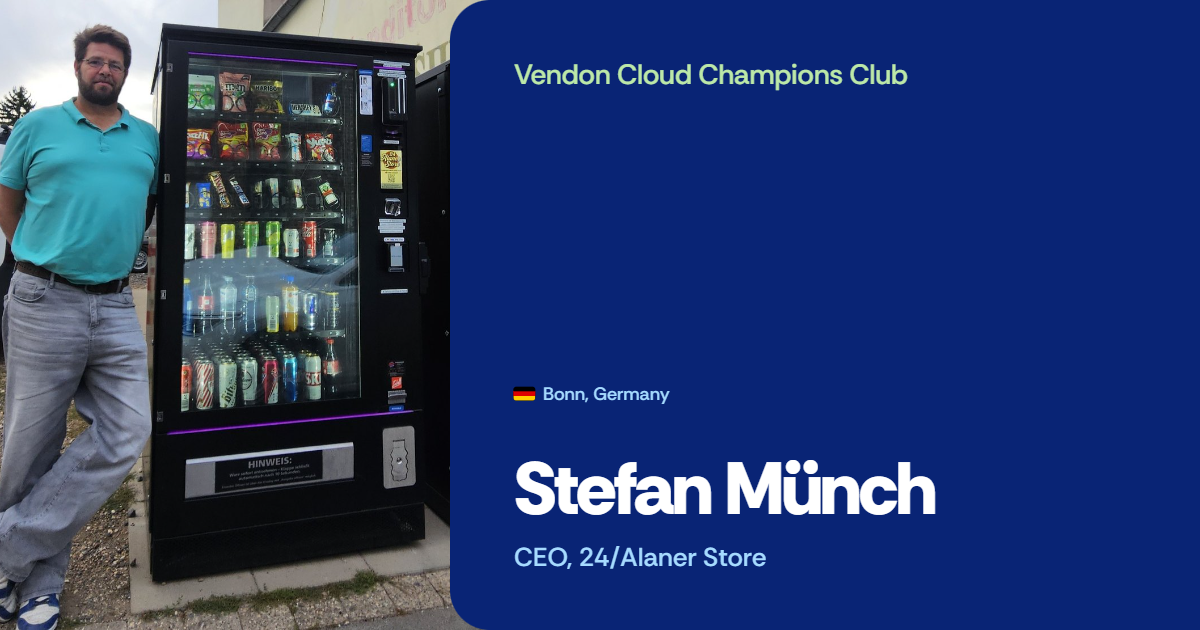
That’s the question vending machine owner Stefan Münch asked when analyzing product placement on his vending machines. He runs three snack machines around Bonn, Germany. Eight months of Vendon Cloud data showed him which products deserve their space – and which ones are first in line to lose it.
The problem
Shelf space is the scarcest resource in vending. Every slot given to a slow seller is a slot that earns nothing – and with three Sielaff snack machines plus a coffee machine spread across a kiosk, Stefan Münch couldn’t afford layouts that had grown out of habit instead of performance.
- Some products had several facings – the same product occupying several slots side by side, so more of it is visible and available – yet barely moved.
- Others sold out constantly from a single slot.
- Refilling ran on gut feeling and on what looked empty, not on what actually made money.
Does each product deserve its space?
Stefan opened his Vendon Cloud sales reports for January through August 2026. His purchase prices are stored in the system, so the reports show him profit – not just turnover.
Then, for every product, he asked one question: how much of the machine’s sales does it bring in, compared to how much of the machine’s space it takes up? In Vendon terms: its share of sales against its share of capacity.
The rule of thumb: a product using 10% of the slots should bring in roughly 10% of the sales. If it brings in much less, it’s over-spaced – holding room a better earner could use. If it brings in much more, it’s under-spaced – give it more slots and it will likely sell more.
Answer: Six products didn’t earn the room they were given
The answer came back clear. Six products didn’t earn the room they were given. And one product was the exact opposite: Reissdorf Kölsch, a popular Cologne beer, sold 139% more than its share of space. Customers wanted it – the machine simply didn’t hold enough of it.
Which products earn the most per slot?
Fixing the space imbalance was half the job. The other half was knowing which products earn the most per slot.
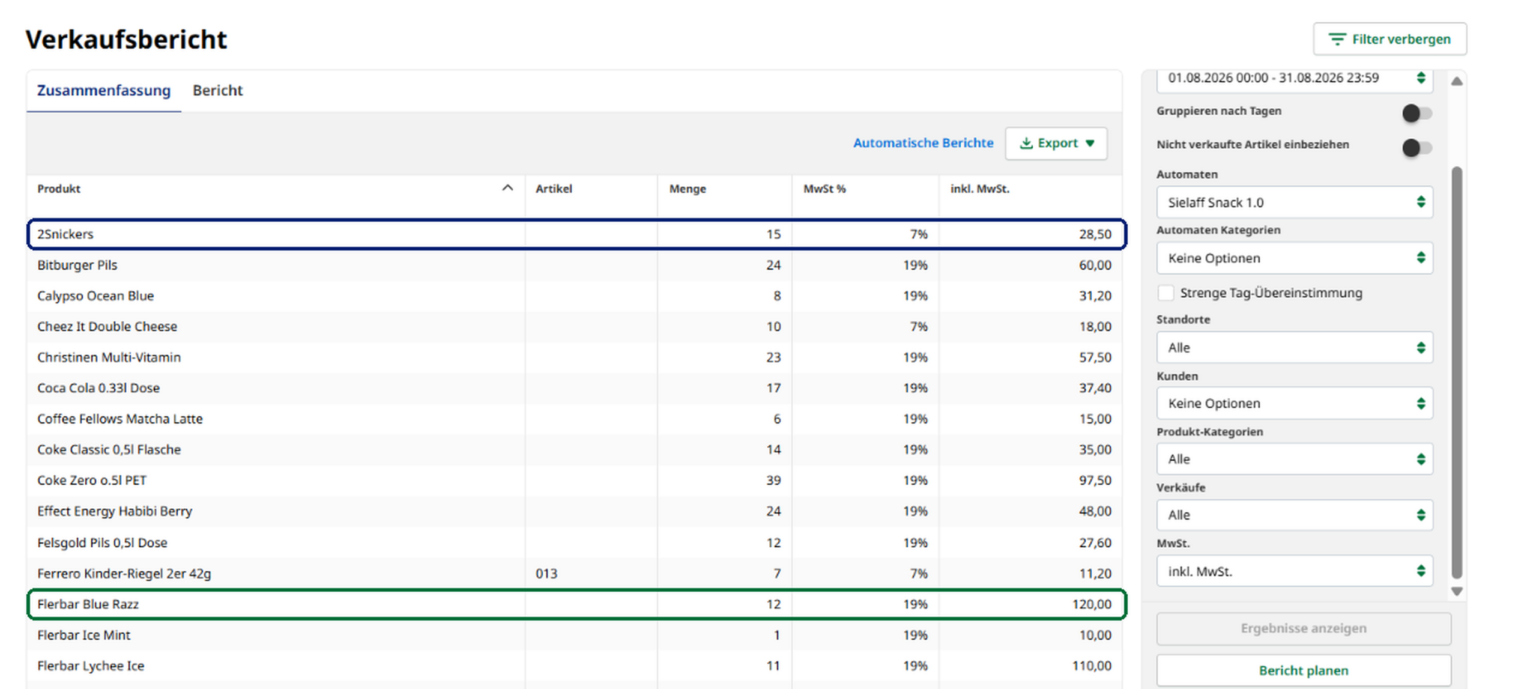
Vendon Cloud’s gives a fast first read on that: it can rank products by unit volume – how many pieces sell. Useful for most assortments. But Stefan’s machines carry premium items like Flerbar Ice Mint, a disposable vape, and Jack Daniel’s Cola, a pre-mixed whiskey-and-cola drink. They sell fewer pieces than a typical snack – but each sale earns far more. A units-only ranking undersells exactly this kind of product. Stefan knew his data could tell him more.
So he kept the units ranking as a starting point – and built his own ranking from the raw sales and profit data in Vendon Cloud. His metric was simple: earnings per slot per month – the monthly profit a product generates, divided by the slots it occupies.
Analysis that turned the table upside down
The premium products came out on top.
- Flerbar Blue Razz, a blue-raspberry disposable vape, earned almost six times more per slot than the weakest products
- Jägermeister, the herbal liqueur, earned about 3.5 times more
- And the cheap products fell to the bottom. They sold piece after piece – but they took up so much space that each slot they occupied earned very little.
The plan: who gets the space next
The ranking gave Stefan a running order for his next layout change. The top earners get more facings – and so does the under-spaced Reissdorf Kölsch, which is still on a single facing today. The six over-spaced products give room back. And Flerbar Ice Mint and Jack
Daniel’s Cola – the two premium products a units-only view would have dropped – stay, because the margin data makes that call easy to defend.
Nothing has moved in the machines yet, and that is deliberate. A planogram has to hold for months, so Stefan wanted the ranking settled before touching it.
Jack Daniel’s Cola
Bonn (Germany)
Stefan's advice to other operators
“Dig into the raw numbers behind the quick views – the units ranking is your starting point, but your business runs on margin.” With purchase prices stored in Vendon Cloud, he sees profit – not just turnover – and can compare locations against each other, without ever standing in front of a machine.
This story is part of the Vendon Champions Club – a series in which people from the field share what changed after they started working with Vendon, and began planning the day on real figures rather than experience alone.